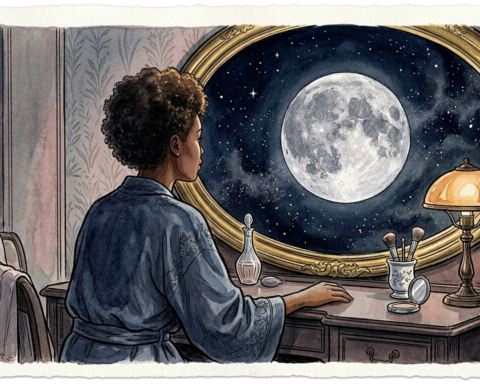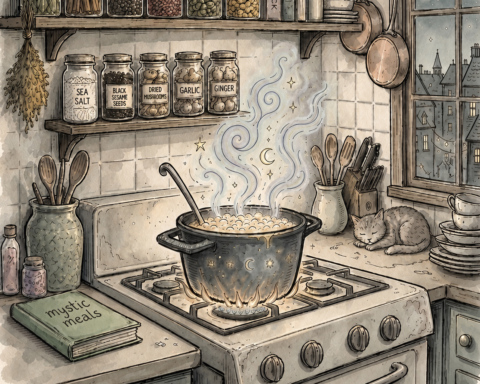

Your home knows things about you that you have never told another person. It was present for the moments you have spent years editing out of your own story, and unlike everyone else, it cannot be charmed, misled, or carefully managed. Psychic and local real estate agent, Jessica Belmonte knows it has something to say about all of it.
Belmonte, who grew up in Los Angeles, is now based in Salinas, and has a professional skill that does not appear on most Zillow listings: she communicates with houses. Not metaphorically or in the sense of “I really feel this space.” She grounds herself, directs her attention toward a specific address (if not physically present), and receives from the building itself coherent information, such as opinions, memories, personality, and on at least one occasion, a pointed critique of interior design choices.
She moved often as a child, and what she observed across her myriad of experiences was this: a person does not remain entirely the same from one address to the next. In one home, a person might be kind, care-free, and cheerful. In another, they’ve become tense or diminished. “From a young age,” she told me, “I knew spaces were pretty special.” It would take her until her thirties, and a women’s group focused on intuition and self-trust, to discover that the relationship could go both ways.
“I introduced myself. I said hello,” she recalled, describing the first time she deliberately connected with a home, sometime around 2022 or 2023. “And the home was absolutely shook!”
She laughed, but she was not joking. The home recovered and responded, in a voice that felt masculine, direct, almost businesslike. The session was brief. Belmonte was astonished. Her mentor was astonished. The home, having never been spoken to quite like this before, was apparently astonished most of all!

Before going further, a note on what Belmonte is not describing. She is not talking about ghosts. She is not describing the residual energy of former occupants, the whispers of the restless dead, or anything that would require a priest or camera crew. Entities and spirits are a separate matter, one she routes to other specialists and declines to take on herself. What she is talking about is the consciousness of the building itself: something she believes is intrinsic, original, alive in its own right, and entirely distinct from whatever else might be haunting the guest bedroom.
This distinction opens a door, so to speak, onto a genuinely fascinating set of questions about the nature of consciousness.
Where does a home’s consciousness come from? Belmonte’s answer has a kind of developmental logic to it. It begins with the intentions of the people who build the structure. Those intentions set a tone, an orientation, or something like a prenatal character — and they go a long way toward explaining why homes, in her experience, are so reliably oriented toward serving and supporting the people inside them. If a home is built with the intention of shelter, safety, and providing someone a life, that purpose becomes foundational to its consciousness. It is, in a sense, what the building believes it is for.
Which raises an uncomfortable corollary. Belmonte has not yet read a prison, but she has thought about what she might find if she did. A structure built to contain rather than to nurture, designed around control and punishment rather than shelter and growth, would presumably carry a very different foundational intention. She has encountered no home or building she would describe as intrinsically dark, and she is careful not to speculate too far beyond her own experience. But the implication is there: consciousness begins where intention begins, and intention is not always benign.
Once construction is complete, the home begins to experience the world the way any new consciousness does: raw, impressionable, and easily startled. She has done readings on buildings just a few years old and found them describing their first encounters with strong wind as frightening. “They were rattled,” she said. “They didn’t know what it was. Later on, they figured it out.” New constructions, in other words, are essentially infants and still assembling their understanding of reality.

Older buildings are something else entirely. They are richer and more set in their ways. Some have grown proud. One house she read, freshly renovated, spent much of its reading essentially bragging: “You should see the other houses. None of them have this! None of them look like this!” Others are wistful. She has had units in apartment buildings lobby for renovations after envying what neighboring units had done. Buildings, it turns out, are not immune to keeping up with the Joneses.
In Belmonte’s experience, an apartment building does not have one consciousness but many. The building itself holds an overarching awareness or consciousness as a whole structure. But each individual unit carries its own entirely separate consciousness, with its own personality, its own memories, and its own feelings about the people inside it. When Belmonte does readings for clients in multi-unit properties, she asks for the specific unit number, because what she receives from the building at large may not apply to a particular apartment at all. The building’s consciousness is, in a sense, the landlord. The unit’s is the home.
The logical follow-up is whether individual rooms within a unit have their own consciousness too. They do not, and Belmonte has wondered about this without arriving at a satisfying explanation. “I wish I could have an answer to that,” she said. What rooms do have is their own distinct energy flow. A bedroom may support communication; it would make an ideal home office or the right setting for important conversations. A corner of a room may carry a particularly strong current for financial thinking. A kitchen blocked off from the rest of the space, surrounded by stainless steel and walls, may lack what she calls fire energy, leaving the home beautiful but emotionally flat, and prone to pushing its residents toward extremes. Consciousness speaks as a form of awareness. Energy moves like weather.
Buildings that have been repurposed carry their own complications. A commercial building converted to residential use goes through something like an identity crisis. “It has all this history, all this memory,” she said, “and now it’s trying to figure out: how am I supposed to serve the people here now?” The building is not confused about its address. It is confused, in some more fundamental sense, about what it is — a disorientation most of us recognize from our own lives, if not from our load-bearing walls.
A home’s consciousness, as Belmonte understands it, operates on an entirely different axis from the human psyches it interacts with. It does not accumulate trauma the way people do. It does not judge. It does not hold grudges. When something violent or painful has occurred within its walls, it retains what she calls an energetic imprint, a memory, but this does not wound the building the way it might wound a person. The imprint lingers and creates stagnation, a kind of blocked energy that prevents the natural flow of the space. And here is the part that matters: the home cannot clear it out on its own. “It needs people to cleanse it,” Belmonte said. The relationship, in this respect, is mutual. The home serves and supports its residents; the residents restore and tend to the home.
Her practical advice for clearing stagnant energy is surprisingly simple. Open the windows. This is the remedy homes request most often, and they each have their own preferences about when: some want the windows open during the day, others at night, others whenever possible. Wash the walls and the floors with the intention of clearing the space. Speak affirmations into the rooms. Declutter. Repair what is broken. Bring in warmer colors or candles if that fire energy has gone flat. Rearrange the furniture if the flow has become blocked. Many homes, she said, ask simply for air.
The home’s consciousness also, importantly, precedes and exceeds its residents. This is perhaps the most striking element of Belmonte’s framework. The energy of a space is more powerful than the person living in it. “I have found that it can go both ways,” she said, when I asked whether the person shapes the place or the place shapes the person. “But the home, the space… it’s definitely stronger.” Move into the wrong home and it will not simply fail to help you; it may actively impede you. Expose yourself to the right one and it can accelerate growth, clarify purpose, and attract opportunity. What most people misunderstand about choosing a home, Belmonte believes, is that they evaluate only the visible: number of bedrooms, price, commute, square footage, and so on. They are missing the unseen relationship they are entering into. A home can support your higher self, or merely serve your immediate needs. Sometimes those are not the same thing.
Consciousness, in Belmonte’s understanding, is not a property exclusive to organic life. It is something that can crystallize wherever sufficient intention, attention, and interaction accumulate — in buildings, in trees, in the land beneath a structure, and in the smaller objects of daily life. She now speaks to her car, which she has named “Kimberly,” cheering it along on difficult drives. She thanks her pens. She tells her computer it is doing a good job. She is aware of how this sounds. But since she began communicating with homes, she said, she feels less alone, more consistently grateful, and more in awe of her life and everything in it.
“What we have created and built,” she said, “we are putting our own soul into these things. And it reflects back our own consciousness.”
There is something almost recursive about this idea: that consciousness, in reaching outward and imbuing objects with attention and intention, discovers its own reflection looking back. That the homes we build are, in some sense, portraits of us, and that those portraits, given enough time and enough life lived within them, develop opinions of their own.
The home Belmonte knows best is her own apartment in Salinas. Its personality surprised her. She had expected warmth, something grandmotherly and easy. What she got was something more composed, calm, sophisticated, and a little formal. Her apartment, as it turns out, does not care for her décor and has shared those opinions plainly, the way a blunt but well-meaning friend might. It has also informed her that the large tree outside the window is its closest companion. The home asked her to keep the blinds open so the two could communicate more easily. She obliges. It is a small accommodation, she said, for a friendship she did not expect to be keeping.
The most dramatic reading she has conducted involved a woman whose home had spent thirty years with her and her family, the only life it had ever known. When the woman began trying to sell, things went persistently, inexplicably wrong. Belmonte was brought in, and the source of the problem became clear: the home did not want her to leave. It had been doing what it could, within its considerable energetic means, to discourage prospective buyers. Belmonte served as something like a couples therapist, helping the home understand that releasing its resident was itself an act of love, that the resident would be okay, and that new people could be welcomed without betrayal. The woman ultimately decided to stay a while longer. The home, one presumes, accepted this with something like relief.
There are also homes that have cared for their residents enough to protect them from unworthy lovers. One client, Belmonte said, had never been able to bring a romantic partner home. She could not explain why it never quite happened. The home had been actively keeping men away until the right person arrived. Eventually, he did. He was allowed in.
Regarding the other multi-faceted desires of the spaces we occupy, Belmonte alludes to homes wanting things from us beyond mere occupancy. They want to be named. When a home receives a name from its owners, something shifts in it, “almost like someone straightening their back and being so proud.” A name confers recognition. It acknowledges that what lives within those walls is not merely architecture.
They also want their thresholds honored. When you pass through a doorway in your home, the front entrance, or an archway between rooms, and tap lightly on the top of the doorframe or arch, the home experiences it as a hug. Belmonte compared the sensation to a cat purring, a small shiver of recognition moving through the structure. It is a strange thing to picture. After speaking with her, it’s impossible not to try!
And then, over time, homes want you gone. When a home has given you everything it has to give, shepherded your growth, provided all the lessons it was meant to provide, it begins to engineer your departure. The space that once felt like sanctuary starts to feel tight. Things that never bothered you begin to bother you. Small problems accumulate. You find yourself restless without quite knowing why. “You’ve grown,” Belmonte said, speaking in the voice of a building with nowhere left to take you. “I’ve done everything for you.” Free will remains operative, and you can stay as long as you choose. But the home, she says, is always working in your best interest, even when that means nudging you toward the door.
I asked what she thought homes would say to humanity, collectively, if they could. She had been sitting with the question for days.
“They want people to know they are there to serve,” she said finally. “And that if people had more awareness of how they could be helping, energetically, they could serve us to an even higher capacity than they currently are.” She paused. “We just don’t know how to receive it.”
Our homes see us unmasked: tired at the sink, crying in the hallway, laughing alone in the kitchen, becoming ourselves in private increments. They do not judge. They do not make assumptions. They observe, and they try to understand, and they try to support. “Our homes truly, truly know us,” Belmonte said. “They know us to our core.”
To get in touch with Jessica for house readings, please call or text (831) 235-3434