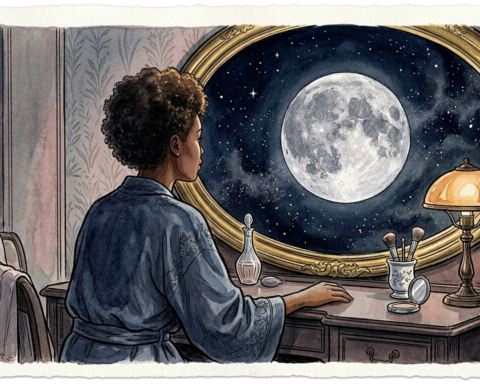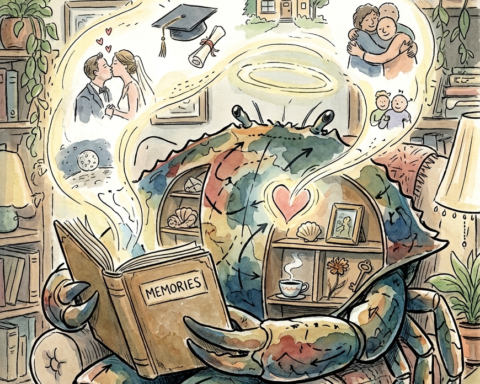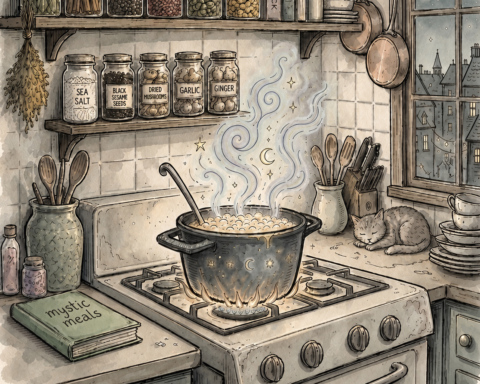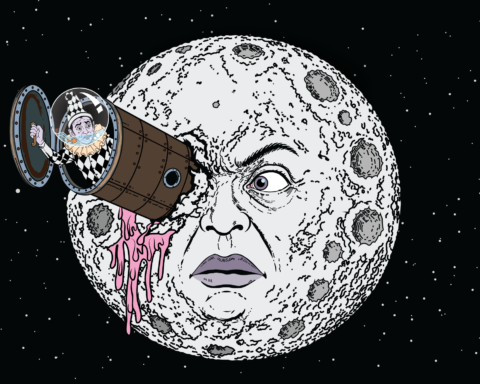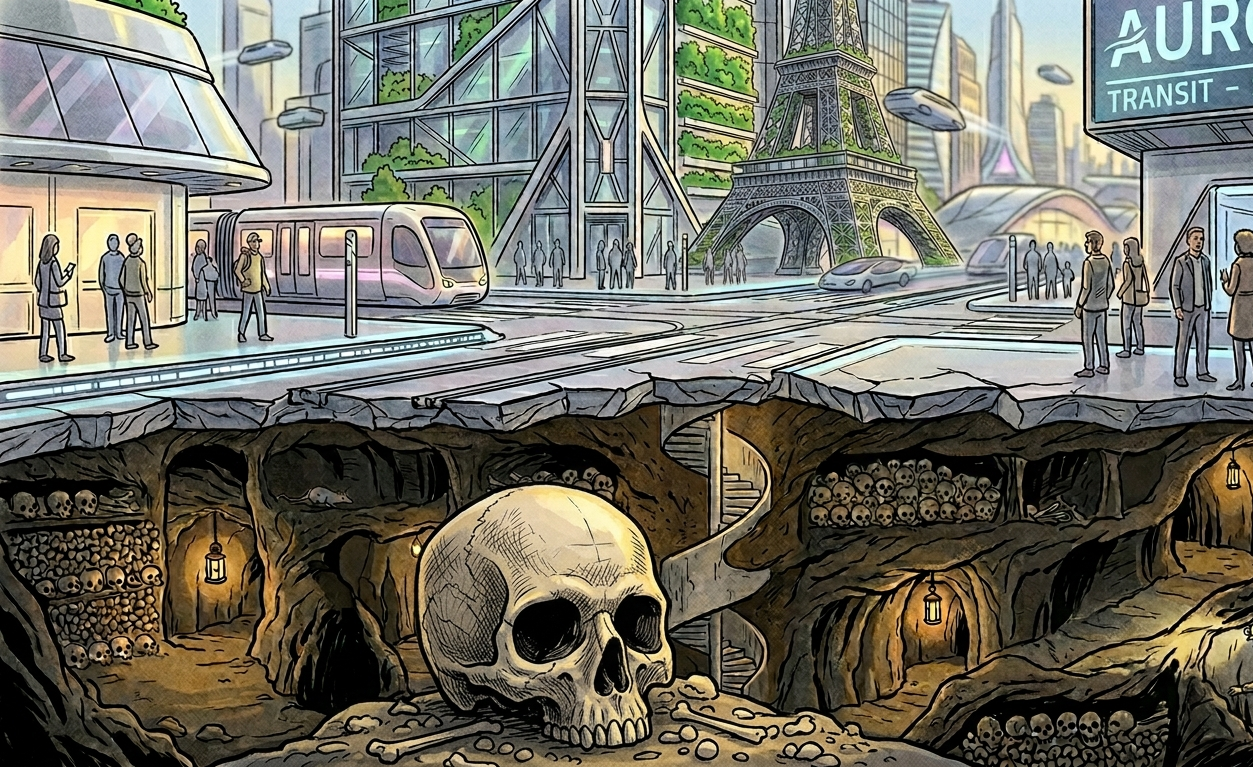

We often treat our family history like a dusty museum exhibit. We look at the faded photographs of ancestors and see strangers, a convenient fiction that allows us to believe we are self-made. In reality, we are walking archives. We are the biological holding cells for every unsaid grief and unresolved debt our lineage ever accrued. In honor of Cancer season, we must look at the sign of the Moon and the Mother not just as a source of nurturing, but as the seat of our inherited structure. The Crab carries its house on its back. You, it appears, are carrying the energetic density of a century of patterns you didn’t choose.
Consider a woman who, at thirty-three, develops a sudden and paralyzing fear of small rooms. She has no memory of trauma to explain it. Her nervous system, however, behaves as though it is under siege. Only later does she learn that her grandmother, at the same age, spent months hidden in a cellar during wartime. This is not coincidence. It is structural memory in the family psyche that nobody thought to mention was there.
A pattern is not a habit. It is the fossil record of a survival strategy. A great-grandmother who lives through famine, or through a marriage she cannot leave, develops a particular way of bracing against the world. That bracing keeps her alive. Passed down unexamined, it becomes something closer to a prison for her descendants. In a candlelit room, this gets called a generational curse. In a laboratory, it gets called epigenetic inheritance. Science and spirit are, here, simply using different dialects to describe the same event: the past does not stay past.
The French psychologist Anne Ancelin Schützenberger built a career on this exact premise. In The Ancestor Syndrome, she described families bound by invisible loyalties or unconscious repetitions that persist because an earlier chapter of the family story was never properly closed. Her genograms, family trees annotated with dates and traumas, revealed uncanny alignments: children falling ill in the same month a grandparent died, marriages collapsing at the precise age a great-grandparent’s marriage collapsed. What she was mapping, in clinical language, is what ancestral-healing traditions the world over have always mapped in ritual language: the family line as a single organism with a long memory, and its members as nodes still carrying the charge.
Spiritual traditions have long insisted that emotion is not abstract — it is energy. This is not so different from what modern bioelectric science already accepts as fact: the heart generates the body’s largest electromagnetic field, nerves fire by electrical signal, and every emotional state produces a measurable shift in the body’s electrical activity. Where mainstream medicine stops at describing this field, energy healers pick up the thread and ask the more interesting question: what happens to that charge when the event that produced it is never discharged?
Valerie Hunt, a UCLA physiologist who spent decades measuring the human energy field with electromyography, proposed exactly this. In Infinite Mind, she described the field as a transactional reality; a repository holding both personal memory and the memory of the biological lineage, in which unresolved trauma persists as a chaotic frequency that continues to draw on the body’s energy simply to maintain itself. This is the direct spiritual counterpart to what a somatic therapist means when they say trauma is “stored in the body.”
The occult tradition names this storage system precisely. Manly P. Hall, writing in The Occult Anatomy of Man, described an invisible body surrounding the physical one; an auric ledger recording every impression a life, and a lineage, has ever made. Vedic philosophy offers an even more exact mechanism: the samskara, a groove worn into the subconscious by repeated emotion, deep enough that a descendant experiences it not as thought but as compulsion. Paramahansa Yogananda, in The Essence of the Bhagavad Gita, described these grooves as accumulating electrical voltage with every repetition, until the self feels not a memory but an impulse, or an involuntary discharge of ancient energy stored in the spine and brain. This is, almost word for word, what a trauma-informed doctor now means when they describe the nervous system as “keeping score.”
Cancer governs a creature protected and housed by a hard shell and, eventually, a little imprisoned by it. A family pattern held too long calcifies the same way: what began as protection becomes a barrier that keeps new energy from entering the system at all.
Daniel Foor, author of Ancestral Medicine, describes ancestors as existing in one of two states, vibrant or hungry. An unsettled ancestor, one whose grief or harm was never metabolized, exerts a quiet and continuous pressure on the living, a kind of ghostly undertow felt as anxiety, illness, or repetition with no obvious cause. This is why affirmation alone so rarely dissolves a real pattern: positive thinking addresses the story a person tells about themselves, but a nervous system convinced it is still living through famine, or through the war in the cellar, does not stand down because it has been told a kinder story. It stands down when the charge itself is moved.
Homeopathy’s founder, Samuel Hahnemann, arrived at a strikingly similar diagnosis two centuries earlier. He proposed the miasm — a predisposition toward illness and imbalance, inherited across generations, a pre-physical stain left on the vital force by an ancestor’s unresolved suffering and passed to the child through what he called the etheric fluid of the parents. Homeopaths still work with this concept today, treating a chronic pattern not as the patient’s own malfunction but as an inherited disturbance requiring its own remedy. It is the same intuition modern epigenetics arrived at from the opposite direction: Mark Wolynn, in It Didn’t Start with You, describes how a future embryo, in its earliest form as an unfertilized egg, is already sharing a cellular environment with its mother and grandmother, providing biological proof that the family’s history begins accumulating in the body before any single life does.
To the spiritualist, this accumulated history is the inherited karma or what some might even call a generational curse impacting the family line. To the scientist, it is a pattern of gene expression. Both are describing a signal that has been running on repeat, generation after generation, simply because no one has yet re-tuned the station.
Breaking a pattern this old asks for more than insight, but release. A few approaches, drawn from both the somatic and the spiritual, tend to work together rather than against each other:
Conduct an audit. Name your three most persistent fears. Pay greater attention to the ones that feel like factory settings rather than choices. For each one, ask plainly: is this mine? Identifying a possible debt is the first step in closing the account. Consider therapy.
Discharge the voltage somatically. Ancestral energy stored in the body tends to respond to movement, breathwork, shaking, or vocal release: practices like TRE (tension and trauma releasing exercises), breathwork, or simple unstructured movement, are more reliably effective than changes in thought alone.
Work the ancestral line directly. Ancestral altar practice, lineage meditation, or guided ancestral-healing journeys, such as those taught by Daniel Foor and others, give the “hungry” ancestor somewhere to be witnessed, which is often what settles the pattern more than analysis ever could.
Address the vital force, not just the symptom. Many who carry an old family pattern find homeopathic constitutional treatment, or other energy-based modalities such as Reiki, acupuncture, or craniosacral work, useful precisely because these approach the disturbance at the level of the field rather than the single symptom.
Close the loop consciously. Whatever the ancestor could not finish, the grief unexpressed, the debt unpaid, the story untold, name it aloud, even privately. Resolve it in your own body and your own words, and the ancestor stops being the builder of your house. Let them become a vibrant presence at your altar.
None of this requires you to abandon the language of biology for the language of spirit, or the reverse. The two have simply been describing the same inheritance from two different rooms in the same house. The work is the same either way: find where the old current is still running, and finally, deliberately, ground it.